

Climate Collapse and the Capitalist Mutilation of the Displaced Female Body
"The ruling-sex acts as the wasteful, destructive rulers of survival, while relying entirely on the labor of women to clean up, manage, and absorb the shockwaves of their destruction."
By Fatima Amir
Climate collapse is routinely presented by states, corporations, and subservient liberal institutions as a universal crisis affecting a vague, unified “humanity.” We are told that we are all in the same boat, that climate change is a collective human failure, and that greenhouse gases do not discriminate. This is a calculated, deeply insidious lie. It is designed to hide the fact that the death of our ecosystems is not a tragic accident of human nature, but the direct result of centuries of global male conquest. As French radical feminist Françoise d’Eaubonne prophesied in her 1974 manifesto Feminism or Death, the destruction of nature and the subjugation of women stem from the exact same phallocratic logic of unlimited mastery. For generations, men from the imperial core have violently seized land, forced human beings into labor, and raped the periphery and the earth to feed their insatiable appetite for wealth, dominance, and territorial control. This global carnage is the ultimate materialization of a male entitlement so absolute that it treats the entire living biosphere as a disposable resource.
This phallocratic conquest views everything—the forest, the river, the soil, and the female womb—as a passive frontier to be broken, tamed, and strip-mined for profit. They stripped the Third World bare, extracted its lifeblood, and left women to live, work, and die in the toxic wreckage of their empires. By framing environmental degradation as a generalized human problem, the ruling class projects the true perpetrators of ecocide onto the grassroots. The abstract concept of “anthropogenic climate change” shifts the blame from a specific class of male conquerors onto the human race as a whole. This erasure is intentional. If everyone is responsible, no one is accountable. The corporate-state complex wants us to forget the history of European colonial plunder. They want to erase the bloody lineages of industrialization, colonization, imperialism, and militarism—systems conceived, built, and defended by men to institutionalize their supremacy over the natural world, subjugated nations, and the female sex. Universalizing this guilt is the crowning deception of male gaslighting, a desperate maneuver to insulate a global ruling class from the revolutionary fury of those they have exploited.
The historical foundations of modern climate collapse are rooted in the violent restructuring of the global economy by male imperialists. Conquered lands across Africa, Asia, and the Americas were forced into brutal systems of plantation farming, intensive oil drilling, and destructive mining operations designed to bleed nature dry for European and North American markets. These ecosystems were not viewed as living networks to be sustained, but as objects for penetration, extraction, and monetization. Imperialist powers managed the resulting ecological ruin through manufactured famines, forced agricultural restructuring, and outright land theft.
This systemic devastation was executed across British-occupied South Asia, where imperial administrators enforced massive grain exports to line London’s financial markets while engineering the catastrophic Bengal and Madras famines, leaving millions of indigenous people to starve on their own plundered soil (Davis, 2000). Simultaneously, across French-occupied West Africa, colonial authorities violently seized agricultural heartlands to force monoculture cash-crop production like cotton and rubber, deliberately ruining social relations and infrastructure, the ancestral land networks that local women relied on for community sustenance, and local biodiversity. This parasitic dynamic stabilized wealth and security in the ruling states of the imperial core by forcing artificial starvation, environmental degradation, and systemic deprivation onto colonized peoples.
During the British colonization of Ireland, millions of tons of grains, cattle, and butter were aggressively exported to London while the native population was forced into artificial starvation; just as the Belgian-occupied Congo was violently re-engineered into a forced-labor rubber factory, decimating the Indigenous population to fuel European financial growth (Coundouriotis, 2012; Kinealy, 1994). This global plunder did not end with the formal collapse of empires; it merely changed its vocabulary. This dynamic reflects what Marxist-feminist theorist Maria Mies (1986) identified in her work Patriarchy and Accumulation on a World Scale as the basis of primitive and ongoing capital accumulation: a system where capitalist patriarchy violently externalizes its ecological destruction onto colonies while exploiting women as the most inexhaustive unpaid workforce.
Today, neocolonial dependency endures under the guise of “global trade” and “international development.” This economic trap is engineered by international financial institutions whose structural adjustment programs force indebted Third World nations to slash social safety nets, privatize public assets, and implement aggressive extractivist policies (International Monetary Fund, 2024). This is financial warfare waged by suits and ties against the womb of the earth. To acquire the hard Western currency required to service these predatory imperial debts, sovereign states are forced to execute the total sacrifice of their own ecosystems to transnational corporations.
This parasitic dynamic is brutally visible in Nigeria’s Niger Delta, where the state-backed cartelization of land by oil giants has systematically poisoned regional water tables, decimated local agriculture, and filled the atmosphere with toxic gas flaring (Saro-Wiwa, 1995). The neocolonial trade regime justifies this ecocide as a necessary metric for national economic development; forcing local women to absorb the immediate physical and economic ruin of plundered lands just to expand the financial assets of the First World (Otuisi et al., 2025). The blood of these dying landscapes is the liquidity that funds Western luxury. Plundered nations remain trapped in a predatory international division of labor where their natural resources and human labor are continuously extracted to fuel Western overconsumption, rather than for feeding, sheltering, and protecting their own people. Global supply chains operate as lines of raw extraction, funnelling energy and resources out of the Third World and directly into the metropoles of the First World. This economic structure ensures that the environmental costs of imperialism are always borne by the most vulnerable, while the financial rewards are concentrated in the boardrooms of male corporations.
In the villages, coastal regions, and agricultural heartlands of the Third World, environmental collapse is the daily, agonizing, and physical destruction of life. As prolonged droughts turn fertile earth to dust, as erratic floods wash away entire generations of crops, and as rising sea levels poison the freshwater table with saltwater, the male class does not adapt by altering its consumption. This visceral breakdown is clear in the Mekong Delta of Vietnam, where rising sea levels push saltwater miles inland, permanently poisoning freshwater tables and destroying the rice paddies that local women rely on to feed their families (Dang et al., 2024). It is equally devastating across rural Pakistan, where catastrophic floods obliterate generational agrarian infrastructures, forcing families into desperate, climate-induced cycles of sex-based domestic violence and the forced marriage of young daughters (Haider, 2024). Global climate data confirms that these escalating eco-catastrophes do not cause the ruling class to alter their insatiable resource habits; instead, they shift the entire physical weight of this planetary crisis directly onto the shoulders of women (IPCC, 2023).
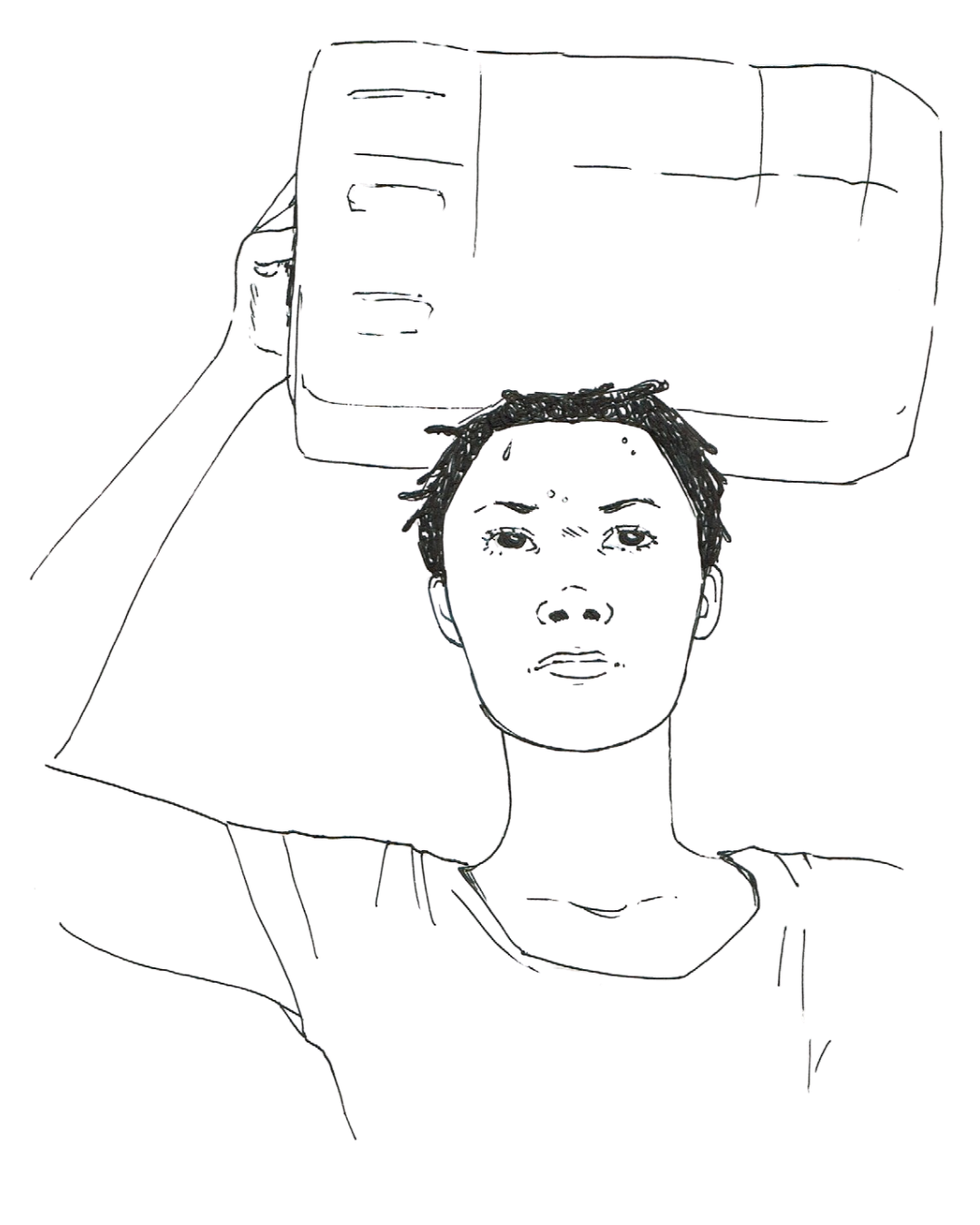
Women carry the burning burden of this environmental breakdown. Men designate women as the sole caretakers of life; they must walk miles each day across scorched terrain to find clean water. This concept is written directly onto the woman’s body—found in the permanent ache of her spine from carrying fifty-pound jerrycans under a blistering sun, the dust that coats her throat, and the raw blisters that score the soles of her feet. They must perform impossible domestic acrobatics to stretch diminishing food supplies to feed their children, often starving themselves so that others can eat. A woman’s stomach remains empty so that the patriarchal family unit can survive another day in the ruins. They care for the sick, the elderly, and the dying as climate-driven diseases spread and public infrastructure rots. As imperialist capital bleeds nature dry, the physical energy and labor required to sustain human life expands exponentially. The more the planet burns, the harder women must work just to keep their families from sliding into the grave. Yet, the male ruling class hoards and violently tightens their grip over wealth and resources through their domination of capital accumulation. Female labor performs the work that keeps the species alive, while men monopolize the authority that dictates the conditions of that survival. They have made women the shock absorbers of a burning world while they sit safely atop the wreckage.
The relationship between ecological instability and bodily sovereignty is clear in labor systems shaped by environmental crises. In Maharashtra’s Beed district in India, recurring droughts and agricultural instability have contributed to widespread debt and seasonal migration for sugarcane labor. Women working within these labor systems often face wage cuts for missing work during menstruation or illness. Under this systemic duress, hysterectomies have become increasingly common among migrant women laborers, many performed at extremely young ages. Investigative field research published by the International Institute for Environment and Development links these surgeries directly to drought, indebtedness, migration, and exploitative labor conditions (Bharadwaj et al., 2024). These surgeries cannot be understood simply as isolated medical decisions, they emerge from economic systems in which menstruation and reproductive needs become materially incompatible with labor exploitation. Women’s physical bodies are violently reorganized and structurally mutilated around the demands of continuous production under ecological collapse, ensuring that menstruation becomes an economically unaffordable liability (Bharadwaj et al., 2024). The long-term physical and psychological effects of these procedures are displaced onto women individually while the structural conditions producing them remain intact. The corporate cartel extracts its profit not only from the plundered soil, but directly from the surgically altered flesh of the female proletariat.
As the land dies and can no longer support agriculture or human habitation, displaced populations are forced to flee, migrating into border zones, urban slums, and crowded refugee camps. This material expulsion is accelerating across planetary frontlines like the Central American Dry Corridor, where multi-year droughts have collapsed subsistence farming, and the Lake Chad Basin, where rapid desertification has completely erased agrarian livelihoods, turning millions of farmers into climate refugees (UNEP, 2023). This mass displacement is a deliberate, engineered containment strategy. The phallocracy constructs these borders to serve as a cage, locking away the human victims of its own ecocidal destruction so that the centers of imperialist and colonial wealth accumulation remain undisturbed.
Within these camps and externalized border zones—such as the Western-funded militarized interception networks and informal containment points across North Africa—survival is fully militarized, bureaucratized, and weaponized. Armed guards, border officials, humanitarian directors, and police officers—architectures dominated entirely by men—control access to life itself. They hold food rations, life-saving medicine, basic shelter, and vital legal paperwork behind endless bureaucratic lines, checkpoints, and discretionary permit systems (Gerard & Pickering, 2014). A woman’s survival in these spaces is reduced to repeated, degrading, and dangerous encounters with male authority. Because men hold absolute, unchecked power over the bare necessities of life, compliance to them becomes the literal price of staying alive.
This horrific reality is rigorously documented by critical migration scholars and international investigative bodies whose field investigations expose how the cartelization of resources within male-dominated border regimes transforms survival aid into a transactional weapon of sex-based violence, where authorities intentionally weaponize basic assets—such as withholding lockable bathroom keys, intentionally cutting electricity to female shower facilities, and hoarding sanitation kits—to demand sexual compliance from displaced women and girls in exchange for passage, basic hygiene kits, and temporary shelter permits (Freedman, 2016). Similarly, independent legal and field investigations monitoring Mediterranean transit hubs expose how Western-funded border authorities in Tunisia routinely withhold basic humanitarian provisions, weaponizing material deprivation through forced encampment in desert zones without drinkable water and the denial of emergency medical transport for pregnant refugees to carry out widespread sexual terrorism, exploitation, and coercion with absolute impunity (OMCT, 2024). This total structural dependency enables widespread sexual violence to be executed across borders without consequence. In the shadow of these “humanitarian” bureaucracies, male trafficking networks, prostitution rings, and violent informal arrangements of exploitation thrive. These predatory systems explicitly target displaced women and girls whose freedom, legal protection, and autonomy have already been stripped away by institutional male power. The refugee camp is not a space of safety; it is a phallocratic microcosm where male dominance is purified, concentrated, and enforced. What the West calls “security” is actually a highly organized ring of human degradation, deliberately engineered to keep the spoils of ecocide pristine.
The conditions experienced by Palestinian women in Gaza vividly expose this relationship with particular severity. The targeted destruction of hospitals, water systems, sanitation infrastructure, and reproductive healthcare facilities has left thousands of women without access to prenatal care, contraception, menstrual hygiene products, or safe childbirth conditions (ActionAid International, 2024; UN ESCWA, 2024). Under these catastrophic conditions, severe shortages of sanitary products have forced many Palestinian women and girls to use torn fabric, old clothing, or even scraps of tents to manage menstruation under forced displacement—routinely stripped of reliable access to clean water, basic privacy, or adequate sanitation facilities (ActionAid International, 2024). The ecological destruction of Palestine demonstrates the convergence of militarized environmental devastation, imperialist-colonial violence, and patriarchal vulnerability. Access to clean water, healthcare, sanitation, electricity, and reproductive safety becomes politically controlled and weaponized through siege, occupation, and deliberate infrastructural destruction. This systematic devastation manifests as what feminist Sylvia Federici (2004) identifies as the ongoing, violent nature of capital accumulation: a structure where the formal economy only survives because the state externalizes the raw cost of physical survival onto the uncompensated, agonizing, and unwaged labor of women. The colonial war machine is not merely asserted through bombs and bullets, but through the deliberate, sadistic engineering of biological squalor. Women’s bodies ultimately absorb the brunt of imperialist warfare through the systematic denial of reproductive care, severe escalation in sexual violence, and acute physical illnesses born from exhaustion and deliberate malnutrition.
This institutional violence within displaced communities and refugee camps does not exist in a vacuum; it directly mirrors and reinforces the reality inside the patriarchal home. Scarcity does not make men cooperate, nor does it inspire them to share the burden of survival. Instead, resource scarcity causes men to tighten their grip on domestic power. Within the household, husbands, fathers, and male relatives maintain strict control over money, physical movement, and access to external humanitarian aid. At the same exact time, as ecological conditions deteriorate, girls are systematically pulled out of school to perform the grueling, unpaid survival labor necessary to keep the family afloat.
Longitudinal tracking across rural agricultural communities in West Africa and Southeast Asia—specifically in Benin, Togo, and Cambodia—has exposed this structural expulsion, revealing that when crops fail, daughters’ futures are sacrificed first (Plan International, 2023). As water tables dry up and regional infrastructures collapse, young girls are forced into a state of domestic servitude, spending up to twelve hours a day walking dangerous, miles-long routes to fetch wood, queue for water, and manage households under siege. Global humanitarian climate tracking indicates that this systematic denial of basic education currently drops millions of girls out of the classroom annually, transforming young female bodies into a free buffer for macro-economic shockwaves (UNICEF, 2025).

The division is plain: our male relatives sat comfortably in the air-conditioned living room, while the women spent hours hidden away in the kitchen or the backyard, burning over the stove fire to accommodate them. The domestic hearth operates as an unmapped colony, a space where women are drained of their physical energy to maintain the leisure of their male relatives. Power chokes women from both sides in a coordinated, multi-layered vice. Men rule survival externally through “humanitarian” institutions and bourgeois states and their military forces, and internally within the family unit. Men govern the macro-structures of society and the micro-structures of the home, while women perform the exhausting, invisible, and uncompensated physical work necessary to keep humanity alive and society functioning. Across refugee camps and household walls, the logic of climate collapse is absolute and unchanging: men control the resources while women do the work to survive. The ruling-sex acts as the wasteful, destructive rulers of survival, while relying entirely on the labor of women to clean up, manage, and absorb the shockwaves of their destruction.
Liberal environmentalism cannot fix this crisis because it fundamentally refuses to name the enemy. Its celebrated “solutions”—sustainability programs, carbon credits, green consumerism, and international charity initiatives—treat planetary murder as a corporate management problem or a technical glitch in an otherwise sound machine. “Net-zero” strategies allow the ruling class in the imperial core to keep consuming fossil fuels and maintaining luxury lifestyles while displacing environmental costs onto the Third World through massive land appropriation and extractive environmental projects. Specifically, these strategies weaponize corporate accounting mechanisms like voluntary carbon markets and REDD+ (Reducing Emissions from Deforestation and Forest Degradation) initiatives. These climate compensation schemes act as a legal back door for oil giants to expand extraction while shifting the ecological bill onto vulnerable populations (Global Forest Coalition, 2024). These ledgers function as corporate execution warrants, transforming local habitats into abstract assets to protect Western capital. Such neocolonial frameworks allow the imperial core to buy fraudulent credits to mask their emissions, executing what critical agronomists identify as “green grabbing”—the violent enclosure and appropriation of land disguised as progressive conservation (Fairhead et al., 2012). They steal land from Indigenous and agrarian communities to plant trees for carbon offsets, greenwashing their ongoing destruction.
This neocolonial plunder is occurring in real-time across the African continent under the banner of market-based climate solutions. Corporate concessions covering millions of hectares of indigenous forest land—amounting to roughly ten percent of Liberia’s total territory and a fifth of Zimbabwe’s landmass—have been aggressively seized through opaque agreements to construct carbon-offset monopolies (Greenfield, 2023). These greenwashing projects function as a new “Scramble for Africa” weaponized by Middle Eastern financial capital and neocolonial regimes to permit continued global pollution through imperialism; consequently, indigenous populations are effectively evicted and local women lose access to customary land tenure and ancestral ecosystems (Welthungerhilfe, 2024). To secure this raw extraction, Western imperial powers prop-up and sustain cozy relationships with these dictatorial regimes. By politically and militarily insulating the autocratic petro-monarchies of the United Arab Emirates and Saudi Arabia, alongside militarized client states in North Africa, the Western imperial core ensures that these regional proxies act in strict accordance with the overarching interests of globalized capital. They brutally police their own populations and project power across the Third World, serving as the enforcement arm of an extractive patriarchal relationship that funnels natural wealth and fossil energy directly to the imperial core.
Even the highly praised “green energy transition” is built on the brutal, low-wage mining of lithium, cobalt, and rare earth minerals in the Third World. Beneath the progressive rhetoric of ‘clean energy’ lies a supply chain that relies on the imperialist plundering of ancestral land and severe sexed exploitation, leaving multinational corporate wealth concentrated firmly in male hands while local women bear the heaviest structural burdens (Maconachie, 2024). In the copper-cobalt mining zones of the Democratic Republic of the Congo, women laboring as mineral washers endure toxic corporate runoff and direct exposure to radioactive materials, driving up catastrophic rates of miscarriages and fetal malformations (Le Guernic, 2024; Maconachie, 2024). This targeted bodily destruction lays bare the fundamental logic of social reproduction under globalized capitalism (Vogel, 2013). The imperialist tech elites treat the reproduction of the Third World workforce—the very capacity of women to carry, birth, and sustain life—as a disposable externality to be chemically sacrificed so that the infrastructure of the First World can be greenwashed. Their land is gouged out to provide clean energy for the tech elites of the First World, while women’s flesh bears the devastating chemical cost of the extraction. This transition merely repurposes the old systems of forced labor and resource theft to build electric vehicles and solar grids for the imperial core.
To make matters worse, international aid programs hypocritically demand that women in affected regions show “community resilience.” This hollow buzzword—“resilience”—is a targeted patriarchal weapon. It is nothing more than code for relying on women’s unpaid, sacrificial labor to rebuild amid the ruin left behind by the ruling class. It expects women to work harder, sleep less, and suffer more to compensate for collapsed state infrastructure, all while keeping the decision-making power and capital concentrated firmly in male hands. It reframes structural abandonment and violence as a personal, spiritual virtue that women must endure silently. This depraved lexicon demands that the victims of ecocide cheerfully romanticize their own slow starvation so the masters of high-tech capital never have to answer for their crimes.
Climate collapse cannot be solved through paperwork, international treaties, recycling campaigns, or polite liberal reforms. Those destroying the earth are the same forces that compound women’s subordination. Environmental destruction and the systematic exploitation of women are not separate issues; they are the twin engines of global imperialist extraction. The ruling-sex treats both the earth and the female body as infinite, disposable resources to be mined until exhaustion. They rape the soil and they rape the female body, driven by the same exact phallocratic entitlement that demands total mastery over all living things. We cannot save our earth without dismantling the structures of male domination that govern it.
To stop the ongoing murder of our planet, we must break their chokehold on survival itself. We must refuse to perform the unpaid labor that keeps their dying, ecocidal system running. We must dismantle the financial strangulation of the Third World by the First, the bourgeois boardrooms, and the phallocratic family unit that traps us in states of manufactured dependency. The survival of the earth requires a total, unyielding strike of the womb and the hand—the absolute refusal to make more toxic waste for women and children to sort, the absolute refusal to breed the next generation of exploiters and workers, and the absolute refusal to absorb the shocks of their violence. Our collective non-cooperation is the ultimate weapon, a sovereign reclamation of the future that will starve their global machinery of its fuel. The only path to a living world is the absolute destruction of male rule; to save our earth, we must reclaim ourselves.